By Rajesh Kumar, Senior Travel Companion with 25+ years of pilgrimage experience
I'll never forget the day Mr. Agarwal wheeled himself into the Golden Temple's marble courtyard. At 68, a stroke had left him partially paralysed three years earlier. His family had assumed his pilgrimage days were finished. But there he sat, tears streaming down his face, surrounded by the sacred pool's reflection of golden domes. "I thought I'd never experience this," he whispered. "I thought wheelchairs and temples didn't go together."
He's not alone in that misconception. Too many people with mobility challenges believe India's ancient temples are forever beyond their reach. Steep steps, narrow passages, and crowded spaces seem insurmountable barriers. Yet in my 25 years of guiding pilgrims, I've watched temple authorities, government bodies, and devoted communities transform accessibility at sacred sites across India.
The truth is this: whilst not every temple offers perfect accessibility, more places of worship are now welcoming wheelchair users than ever before. Some temples have embraced accessibility so completely that mobility challenges become virtually invisible. Others require careful planning and specific arrangements, but the darshan remains achievable.
Let me share the ten most accessible temples in India, along with practical guidance I've gathered from accompanying hundreds of wheelchair users on their spiritual journeys.
What Makes a Temple Truly Wheelchair Accessible?
Before diving into specific destinations, let's establish realistic expectations. Temple accessibility exists on a spectrum, and understanding what "accessible" actually means prevents disappointment.
The gold standard includes:
- Ramps or lifts replacing all major staircases, with gradients gentle enough for self-propulsion or easy pushing. A ramp rising one metre over ten metres of length represents ideal accessibility. Steeper ramps require assistance.
- Wide doorways and passages accommodating wheelchairs comfortably. Standard wheelchairs measure roughly 60-70 centimetres wide. Accessible passages should be at least 90 centimetres, allowing some margin.
- Smooth, even flooring throughout. Marble is excellent. Uneven stone, gravel, or sudden level changes create difficulties.
- Accessible toilet facilities with grab bars, wide doors, and turning space.
- Designated parking close to temple entrances, minimising distance wheelchair users must travel.
- Temple-provided wheelchairs and trained staff assistance for those who need it.
The reality in India:
Few temples achieve every criterion. Most offer partial accessibility, meaning wheelchair users can access the main deity but perhaps not every shrine or area. I've learnt to focus on what matters most: can you have meaningful darshan? If yes, minor accessibility gaps become manageable inconveniences rather than barriers.
Cultural context matters too. Many ancient temples are archaeological treasures where structural changes aren't possible. The question becomes not "why isn't this accessible?" but rather "how can we work within existing structures to enable access?"
Model wheelchair accessibility: Wide ramp with gentle gradient, clear bilingual signage (Hindi and English) marking accessible entrance, handrails on both sides, and trained staff assistance - demonstrating the gold standard for temple accessibility infrastructure.
1. Golden Temple (Harmandir Sahib), Amritsar, Punjab
Accessibility Rating: 5/5 (Outstanding)
The Golden Temple sets India's accessibility standard. Sikh philosophy emphasises equality and service (seva), and this manifests in extraordinary efforts to ensure every devotee, regardless of physical ability, experiences the temple fully.
Why it's exceptional:
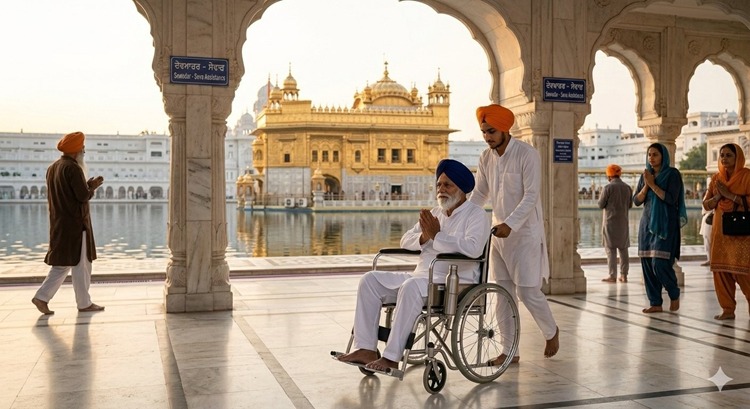
- The entire complex is at ground level. No stairs separate you from any area. Wheelchairs glide smoothly across pristine marble surrounding the sacred pool.
- Four entrance gates, all wheelchair accessible. The main entrance (Darshani Deol) has wide ramps with gentle gradients.
- The marble pathway (Parikarma) encircling the Amrit Sarovar (holy pool) is completely flat and wide enough for wheelchairs to pass comfortably even during crowded times.
- The causeway leading to the central golden shrine has a dedicated wheelchair route. During peak times, volunteers assist in navigating crowds.
Facilities specifically for wheelchair users:
- Temple volunteers (sevadars) provide dedicated assistance. Simply ask at any entrance, and someone will guide you through your entire visit.
- Free wheelchairs available at all entrance points. The quality is excellent, regularly maintained.
- Accessible washroom facilities near all major gates.
- Designated rest areas with seating where attendants can take breaks whilst the wheelchair user continues prayers or meditation.
The spirit of seva at Golden Temple: Volunteer (sevadar) providing compassionate assistance to elderly Sikh pilgrim in wheelchair on smooth marble parikrama, with Harmandir Sahib reflected in the sacred Amrit Sarovar - exemplifying the temple's commitment to accessibility and service.
Practical tips from experience:
- Visit early morning (4 AM to 6 AM) for the calmest experience. The Golden Temple never closes, and pre-dawn darshan offers profound peace with minimal crowds.
- The Langar Hall (community kitchen) is fully accessible. Don't miss this extraordinary experience of shared meals. Volunteers will assist in finding comfortable seating.
- Photography is allowed, making this one of the few temples where wheelchair users can document their spiritual experience freely.
Accommodation note: Temple guest houses offer free accommodation, but advance booking is essential and facilities vary. We arrange nearby hotels with proper accessibility features for elderly wheelchair users who need specific amenities.
2. Kashi Vishwanath Temple, Varanasi, Uttar Pradesh
Accessibility Rating: 4.5/5 (Excellent)
The recently completed Kashi Vishwanath Corridor has revolutionised accessibility at one of Hinduism's holiest sites. What was once nearly impossible for wheelchair users is now genuinely achievable.
The corridor's accessibility features:
- Wide, paved pathways spanning approximately one kilometre from entry points to the main temple. The surface is smooth granite, ideal for wheelchairs.
- Ramps at all level changes. The corridor's design prioritised accessibility from the beginning.
- Covered areas protecting from sun and rain along most of the route.
- Rest areas with seating every 100 metres. These pavilions allow attendants and wheelchair users to pause comfortably.
- Temple-provided wheelchairs at multiple points. Electric wheelchairs are also available for longer distances.
The temple itself:
The inner sanctum requires navigating some crowds, but dedicated lanes for wheelchair users and elderly devotees speed the process considerably.
During peak times, temple authorities arrange special darshan timings for wheelchair users, typically early morning or late evening when crowds thin.
Challenges to know about:
The old city surrounding the temple remains inaccessible. Stay in accommodation near the corridor entrance points (Manikarnika Ghat or Godaulia) to minimise difficulty.
Crowds during festivals and weekends can be intense. Weekday mornings offer the best experience.
Best time to visit: November to February for weather, avoiding Diwali week and major festivals unless you specifically want that energy (with the crowds it brings).
3. Shirdi Sai Baba Temple, Maharashtra
Accessibility Rating: 4.5/5 (Excellent)
Shirdi has invested heavily in accessibility, reflecting Sai Baba's message of universal love and inclusivity.
Accessibility highlights:
- The main temple complex is predominantly single-level. Where level changes occur, both ramps and lifts are available.
- The Samadhi Mandir (Sai Baba's final resting place) is fully wheelchair accessible via a dedicated entrance.
- Dwarkamai mosque where Sai Baba lived has ramp access. The interior requires some navigation but is manageable.
- Chavadi, another significant site, is accessible with minimal assistance.
Wheelchair access to sacred spaces: Family member assisting elderly pilgrim in wheelchair on wide, textured ramp with sturdy handrails leading to temple entrance, with clear accessibility signage visible - showing how modern infrastructure enables dignified temple access for all devotees.
Special services:
- VIP darshan for disabled pilgrims, arranged through the temple office with minimal documentation (disability certificate or senior citizen ID).
- Battery-operated vehicles transport mobility-challenged devotees between different parts of the sprawling complex.
- Temple volunteers specifically trained to assist wheelchair users.
Facilities:
- Accessible toilets at multiple locations throughout the complex.
- Medical centre with wheelchair accessibility if health issues arise.
- Accommodation in temple trust guest houses includes accessible rooms (advance booking essential).
Practical experience: The queuing system is well-organised. Special queues for wheelchair users and disabled devotees move efficiently. Thursday evenings (Chavadi procession night) see enormous crowds, requiring extra patience and planning.
4. Tirupati Balaji Temple (Tirumala), Andhra Pradesh
Accessibility Rating: 4/5 (Very Good)
The world's richest temple has resources to match its devotion to accessibility. Recent improvements make Tirupati increasingly wheelchair-friendly.
Accessibility features:
- Free wheelchairs provided at multiple locations across Tirumala. The temple owns hundreds of wheelchairs in good condition.
- Special entrance for wheelchair users and disabled devotees, avoiding the main queue entirely.
- Dedicated darshan protocol ensuring wheelchair users reach the deity without navigating crowds or steps.
- Lifts and ramps at key locations, though some areas still require assistance.
The challenge:
Tirumala sits atop a hill. Reaching the temple requires either a winding ghat road or steps. Neither is wheelchair-accessible in the traditional sense.
Solutions:
- Buses equipped for disabled passengers run regularly from Tirupati town to Tirumala. The journey takes 45 minutes.
- For elderly wheelchair users, we arrange private vehicle transport. The road is steep and winding but completely manageable by car.
- Helicopter services offer an alternative, though booking requires advance planning and depends on weather conditions.
TTD (Tirumala Tirupati Devasthanams) services:
- Physically challenged darshan quota allows wheelchair users priority access with minimal waiting (typically 1-2 hours versus 12-14 for general darshan).
- Volunteers assist throughout the process, from parking area to darshan and return.
- Free accommodation in Tirumala includes accessible rooms (book well in advance through the TTD website).
Documentation required: Disability certificate (percentage above 40%) or senior citizen ID (65+). One attendant allowed to accompany.
5. Meenakshi Temple, Madurai, Tamil Nadu
Accessibility Rating: 3.5/5 (Good with assistance)
This architectural marvel has made significant accessibility improvements whilst preserving its ancient structure.
What works well:
- The main entrance and outer corridors are accessible via ramps installed in recent years.
- The temple's predominantly flat layout means most level changes are minimal.
- Temple authorities provide wheelchairs and assistance on request.
- The famous Hall of Thousand Pillars is wheelchair accessible, offering extraordinary architectural beauty.
Experiencing sacred architecture: Wheelchair user with guide inside ornately carved temple hall with intricate pillars and deity sculptures, demonstrating how accessibility modifications preserve spiritual experience while accommodating mobility needs in ancient architectural spaces.
Challenges:
- Some inner sanctums require navigating steps. However, the main Meenakshi shrine and Sundareswarar shrine (the temple's primary deities) are reachable with assistance.
- Crowds can be intense, particularly during Friday evenings and festival periods.
- The temple's vast size (14 acres) means considerable distance to cover. Electric wheelchairs or frequent rest stops are advisable.
Practical tips:
- Morning visits (6 AM to 8 AM) offer the calmest experience.
- Hire a temple guide who understands accessibility needs. They know which routes work best and can arrange assistance when needed.
- The temple allows one attendant to accompany wheelchair users free of charge.
6. Siddhivinayak Temple, Mumbai, Maharashtra
Accessibility Rating: 4/5 (Very Good)
Mumbai's beloved Ganesha temple has embraced accessibility befitting a modern metropolitan temple.
Accessibility features:
- Lifts transport wheelchair users to the main temple level, bypassing all stairs.
- The sanctum pathway is flat and wide enough for comfortable wheelchair navigation.
- Special darshan timings for disabled devotees (typically early morning 6 AM to 7 AM and late evening after regular hours).
- Temple volunteers trained specifically in assisting mobility-challenged devotees.
The VIP darshan option:
Booking VIP darshan (₹500 approximately) provides the smoothest experience. The VIP route is specifically designed for easy wheelchair access and includes minimal waiting.
Timing strategy: Tuesday is Siddhivinayak's most crowded day (dedicated to Ganesha). Avoid unless you specifically want that intense devotional atmosphere. Weekday mornings offer the best wheelchair-friendly experience.
7. Somnath Temple, Gujarat
Accessibility Rating: 4/5 (Very Good)
This beautiful temple on Gujarat's coast has excellent modern accessibility features.
Why it works well:
- Rebuilt in 1951, the temple incorporated modern accessibility from the start.
- Ramps connect all major levels. The approach from parking to temple is entirely ramp-based.
- The temple sits on relatively flat terrain near the sea, eliminating altitude challenges.
- Wide passages throughout accommodate wheelchairs easily.
Special features:
- Battery-operated vehicles transport disabled and elderly devotees from parking to the main temple entrance during peak times.
- Temple volunteers provide dedicated assistance.
- Evening aarti (sound and light show) has accessible viewing areas where wheelchair users can experience the spectacular ceremony comfortably.
Peaceful accessibility: Elderly couple navigating smooth, wide pathways through beautifully landscaped temple gardens with colorful flower beds, handrails, and ramps - demonstrating how accessible design enhances the spiritual experience by allowing devotees to enjoy both temple architecture and surrounding natural beauty.
8. Akshardham Temple, Delhi
Accessibility Rating: 5/5 (Outstanding)
Built in 2005, Akshardham was designed with comprehensive accessibility as a core principle.
World-class accessibility:
- The entire complex is wheelchair accessible. Ramps, lifts, and smooth pathways connect every exhibition, garden, and temple area.
- Complimentary wheelchairs provided at the entrance (leave ID as deposit).
- Staff trained extensively in disability awareness and assistance.
- Accessible toilets throughout the complex, maintained to high standards.
The exhibitions:
- The boat ride (Sanskruti Vihar) accommodates wheelchairs with staff assistance for boarding.
- The film presentation (Neelkanth Yatra) has designated wheelchair seating with excellent sightlines.
- Musical fountains show has accessible viewing areas.
Important notes: Security is stringent. No bags, phones, or cameras allowed inside. Secure lockers provided. The complex is vast (100 acres). Even with excellent accessibility, the sheer distances can be tiring. Electric wheelchairs or frequent rest stops recommended.
9. Jagannath Temple, Puri, Odisha
Accessibility Rating: 3/5 (Moderate, requires planning)
An ancient temple making gradual accessibility improvements whilst preserving its sacred heritage.
Current accessibility:
- The main temple has introduced ramps at several key points in recent years.
- Temple authorities provide wheelchair assistance for disabled devotees.
- Special darshan arrangements for wheelchair users reduce waiting times significantly.
Making it work: Temple volunteers carry wheelchair users up steps where ramps don't exist. Whilst not ideal from an independence perspective, it enables darshan that would otherwise be impossible. The temple administration is genuinely committed to helping disabled devotees.
10. ISKCON Temples (Multiple Cities)
Accessibility Rating: 4.5/5 (Excellent across locations)
ISKCON temples, particularly the major centres in Bangalore, Delhi, and Mumbai, exemplify accessibility.
Why ISKCON excels:
- Modern construction incorporating accessibility from design stage.
- International awareness of disability rights reflected in Indian temples.
- Well-trained volunteers understand and anticipate accessibility needs.
- English-speaking staff assist international and domestic visitors alike.
Specific locations:
- ISKCON Bangalore: Outstanding accessibility. Ramps throughout, lifts to all levels, accessible accommodation in guest house, and inclusive cultural programs.
- ISKCON Delhi: Excellent accessibility. The temple, museum, and restaurant are all wheelchair-friendly.
- ISKCON Mumbai: Very good accessibility with some crowding during festivals requiring extra assistance.
All are welcome: Elderly woman in wheelchair with temple volunteer at accessible entrance featuring glass doors with universal welcome message, wheelchair accessibility signage, and festive marigold decorations - embodying the inclusive spirit of modern temple accessibility initiatives.
Practical Guidance for Planning Your Wheelchair-Accessible Pilgrimage
Beyond specific temples, successful wheelchair-accessible pilgrimages require careful planning.
Pre-travel preparation:
- Contact temples in advance. Email or phone calls to temple offices confirm current accessibility status and arrange special assistance. Temple policies and facilities change; what was true last year might not apply now.
- Book accommodation with genuine accessibility. Don't rely solely on hotel claims. We verify room features: roll-in showers or bathrooms with grab bars, wide doorways, accessible toilets, and ground floor or lift access.
- Plan conservative itineraries. Wheelchair travel requires more time than able-bodied travel. Build in extra time for everything, plus mandatory rest periods.
Choosing the right wheelchair:
- Standard manual wheelchairs work for most temples. Lightweight models reduce attendant fatigue when pushing over long distances.
- Electric wheelchairs offer independence but require charging facilities and can be challenging in crowds.
- Temple-provided wheelchairs are free but first-come, first-served. Don't rely on their availability during peak times.
The attendant factor:
Wheelchair users nearly always need attendants for temple visits. Narrow passages, crowds, and occasional steps require assistance even at "accessible" temples.
Through our services, we provide trained attendants who understand both accessibility needs and temple protocols. They know which routes work best, when to visit for minimal crowds, and how to navigate challenging moments smoothly.
Documentation to carry:
- Disability certificate (if applicable) speeds special access arrangements at most temples.
- Senior citizen ID (for those 60+) provides additional privileges at many temples.
- Medical summary letter if you have significant health conditions requiring emergency intervention.
Managing expectations:
Perfect accessibility remains rare. Approach each temple with patience and flexibility. The goal is meaningful darshan, not barrier-free perfection. I've seen wheelchair users have profoundly moving experiences at temples with significant accessibility challenges because their mindset focused on spiritual connection rather than physical barriers.
What the Future Holds
Temple accessibility in India is improving dramatically. Government initiatives, disability rights awareness, and temple authorities' genuine commitment are creating change.
The Accessible India Campaign (Sugamya Bharat Abhiyan) specifically targets heritage and religious sites for accessibility improvements. While progress varies by location, the direction is clear: more temples will become genuinely accessible in coming years.
Modern temple construction now incorporates accessibility as standard. Ancient temples are retrofitting ramps, lifts, and accessible facilities wherever structurally possible.
Final Thoughts: Devotion Knows No Barriers
Mr. Agarwal, whom I mentioned at this article's beginning, has since visited Shirdi, Tirupati, and Varanasi, all from his wheelchair. His stroke didn't end his spiritual journey. It simply required adapting how that journey unfolds.
Every wheelchair user I've guided through temples has enriched my understanding of what accessibility truly means. It's not just ramps and lifts, though those matter enormously. It's the temple volunteer who instinctively knows when to offer help and when to step back. It's the fellow pilgrim who moves aside in crowded spaces without being asked. It's the priest who ensures darshan happens with dignity regardless of how the devotee arrives.
India's temples are opening their doors wider every year. Your wheelchair doesn't make you less welcome. It simply means planning your pilgrimage with awareness, seeking temples that match your needs, and accepting assistance gracefully when offered.
The divine doesn't measure devotion by the number of steps you climb. Your presence, however you arrive, is what matters.
Frequently Asked Questions
Q: Do I need to bring my own wheelchair, or can I rely on temple-provided wheelchairs?
A: For major temples like Golden Temple, Shirdi, and Tirupati, temple-provided wheelchairs are reliable and well-maintained. However, for multi-day pilgrimages or multiple temples, bringing your own ensures consistent comfort and eliminates availability concerns. Temple wheelchairs operate on first-come, first-served basis during peak periods.
Q: Can electric wheelchairs access most temples?
A: Electric wheelchairs work well at modern temples (Akshardham, ISKCON, Shirdi) with smooth surfaces and ample space. Ancient temples with narrow passages or uneven flooring present challenges. Additionally, charging facilities aren't universally available. Manual wheelchairs offer more versatility for traditional temple settings.
Q: Will I need to transfer out of my wheelchair for darshan?
A: At most accessible temples, wheelchair users can approach very close to the deity whilst remaining seated. Some temples require transferring to temple-provided chairs for the final approach to maintain sanctity protocols. Temple staff assist with this process and ensure dignity throughout.
Q: How do I arrange special darshan for wheelchair users?
A: Contact the temple administration office directly (phone or email) at least one week before visiting. Provide details about mobility requirements and preferred dates. Most major temples have established protocols. Through our services, we handle all arrangements ensuring confirmed special access.
Q: Are attendants allowed to accompany wheelchair users into temples?
A: Yes, virtually all temples permit one attendant to accompany wheelchair users free of charge. Some temples allow two attendants for severely disabled pilgrims. Attendants should dress appropriately according to temple dress codes.
Q: What about accessible toilets at temples?
A: Accessibility varies significantly. Modern temples (built post-2000) generally have good accessible toilet facilities. Ancient temples are retrofitting accessible toilets gradually. Major pilgrimage centres like Tirupati, Shirdi, and Golden Temple have multiple accessible toilet locations. Smaller temples may lack such facilities entirely.
Q: Can wheelchair users participate in temple rituals like abhishekam or special pujas?
A: Absolutely. Most temples arrange wheelchair-accessible ritual participation. Inform temple authorities about your interest in specific rituals when booking. They'll arrange appropriate access and positioning. Your wheelchair doesn't exclude you from any spiritual practice.
Q: Which season is best for wheelchair-accessible temple visits?
A: October through March offers pleasant temperatures across most of India, reducing physical strain. Avoid peak summer (April-June) when heat exhausts both wheelchair users and attendants. Monsoon (July-September) creates slippery surfaces and access difficulties. Festival periods bring crowds requiring extra patience and planning.