By Arjun Desai, devoted son who planned elaborate pilgrimages for his parents
When my parents first mentioned wanting to visit Char Dham, my immediate reaction was worry. Dad was 71 with mild hypertension. Mom, at 68, had arthritis in both knees. The Himalayas? Temples at 10,000+ feet altitude? Unpredictable mountain weather? Everything I read online made me more anxious, not less.
But here's what I discovered after months of research, countless calls to tour operators, and ultimately completing the journey with my parents last year: timing is everything. Choose the right season, and Char Dham transforms from a daunting challenge into an achievable, profoundly meaningful pilgrimage for seniors.
Choose poorly, and you're setting up your elderly parents for unnecessary hardship.
This guide shares everything I learned about seasonal planning for Char Dham, specifically tailored for those of us sending our aging parents on this sacred journey or planning to accompany them.
Understanding Char Dham: Why Season Matters More Here Than Anywhere Else
Char Dham isn't like visiting Varanasi or Shirdi where temples stay open year-round and weather is manageable. These four shrines—Yamunotri, Gangotri, Kedarnath, and Badrinath—sit high in the Uttarakhand Himalayas, at altitudes ranging from 3,133 meters (Gangotri) to 3,583 meters (Kedarnath).
The temples literally close for winter. Heavy snowfall makes them inaccessible and dangerous from November through April. Even during the open season (typically late April through early November), weather varies dramatically month to month, affecting everything from temperature to crowd levels to health risks for seniors.
What makes seasonal planning critical for elderly pilgrims:
- Altitude sickness risk increases in colder months when oxygen levels drop further. Seniors with cardiovascular or respiratory conditions face heightened danger.
- Temperature extremes stress aging bodies that regulate internal temperature less efficiently. A 70-year-old struggling with 2°C morning temperatures at Kedarnath faces genuine health risks.
- Monsoon landslides can strand pilgrims for days. The anxiety alone affects seniors, never mind the actual danger.
- Crowd levels determine everything from queue times to accommodation availability to the simple ability to move safely in confined spaces.
Let me break down each month of the Char Dham season so you can make an informed decision about when to send your parents—or when to go yourself.
Seasonal contrast at Kedarnath Temple: Three views showing the same sacred shrine in May (clear skies, comfortable temperatures, senior pilgrims in light layers), July monsoon (heavy rain, dangerous conditions, warning signs), and September (post-monsoon clarity, perfect weather) - dramatically illustrating why season choice is critical for elderly pilgrims.
Month-by-Month Breakdown: The Complete Senior Citizen Guide
April: The Opening (Not Recommended for Seniors)
Temple Opening Dates 2025:
- Yamunotri: April 30
- Gangotri: April 30
- Kedarnath: April 28
- Badrinath: May 12
Weather Reality: Daytime temperatures hover around 10-15°C. Sounds manageable, right? Wrong. Mornings drop to near freezing (0-2°C). Evenings are bitterly cold. Snowmelt makes paths slippery and dangerous.
Why I don't recommend April for seniors:
- The infrastructure hasn't fully awakened. Hotels are just opening, staff is getting organized, and facilities might not function optimally. My parents need reliable heating, hot water, and comfortable accommodation. April doesn't guarantee this.
- Lingering snow and ice create slipping hazards. Dad's balance isn't what it used to be. One fall on an icy path could end the entire pilgrimage—or worse.
- Roads can still face blockages from late snowfall. Getting stranded in cold conditions with elderly parents is my nightmare scenario.
May: The Sweet Spot Begins (Highly Recommended)
Weather:
- Daytime: 15-20°C (pleasant)
- Morning/Evening: 5-10°C (cool but manageable)
- Rainfall: Minimal
- Snow: Cleared from paths
Why May works beautifully for seniors:
- Perfect temperature balance. Warm enough during the day that walking doesn't chill aging bones. Cool enough that exertion doesn't cause overheating or excessive sweating. This Goldilocks zone is ideal for the 60+ crowd.
- Infrastructure fully operational. All hotels, restaurants, medical facilities, and support services are running smoothly. When I took my parents in mid-May, everything just worked. No surprises, no "sorry, not available yet."
- Clear skies and visibility. The Himalayan views are breathtaking. For many seniors, this might be their only mountain pilgrimage. May offers the clearest views before monsoon clouds arrive.
- Manageable crowds. Yes, it's busy—Char Dham is always busy—but not the overwhelming crush of June. Queues move. You can find quiet moments. My parents could actually enjoy darshan rather than feeling herded through.
Health advantages:
- Oxygen levels are relatively better than later in summer when heat thins the air further. Seniors with respiratory conditions breathe easier.
- The moderate cold actually helps. It's invigorating rather than exhausting. Mom's arthritis bothered her less in cool weather than in heat.
- Fewer pilgrims mean fewer disease transmission risks. Important for elderly immune systems.
My verdict: If I could pick one perfect month for senior citizens, it's May. Mid to late May specifically, when everything's open but crowds haven't peaked.
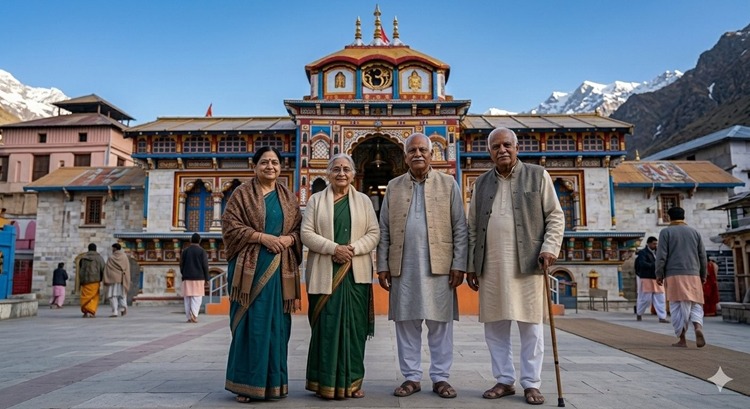
Perfect May conditions at Badrinath Temple: Senior pilgrims dressed comfortably in layered woolens standing before the colorfully decorated shrine, with snow-capped peaks and clear blue skies in the background - showcasing the ideal temperature balance and comfortable darshan experience that makes May the optimal month for elderly travelers.
June: Peak Season (Good with Caveats)
Weather:
- Daytime: 20-25°C (warm)
- Morning/Evening: 10-15°C (mild)
- Rainfall: Increasing toward month-end
- Conditions: Generally good but deteriorating
The reality of June:
This is when everyone wants to visit. School holidays begin mid-month. Families flood the circuit. I watched queue times triple between early and late June when I was researching.
For seniors, June works if:
- You go in the first two weeks before schools close. June 1-15 offers reasonable weather with somewhat manageable crowds.
- You've booked everything—accommodation, helicopter, special darshan—months in advance. June doesn't allow spontaneity.
- Your parents handle heat reasonably well. By late June, daytime temperatures can hit 25°C+. At altitude, that's deceptively tiring.
- You're prepared for higher costs. Peak season pricing kicks in. Helicopter fares jump. Hotels charge premium rates.
Health considerations:
The heat increases dehydration risk. Elderly kidneys don't signal thirst as efficiently. I had to constantly remind my parents to drink water. Altitude sickness risk rises as the season warms. The combination of heat and altitude stresses cardiovascular systems. Crowding means more physical contact, jostling, and disease exposure.
June verdict: First half is acceptable. Second half, avoid if possible.
July-August: Monsoon Madness (Strongly Not Recommended)
Weather:
- Rainfall: Heavy and unpredictable
- Landslide risk: High
- Temperatures: 15-20°C (moderate)
- Conditions: Dangerous
Let me be blunt: don't send your elderly parents to Char Dham during monsoon unless there's absolutely no alternative.
Why monsoon is particularly risky for seniors:
- Landslides happen. Not might happen. Happen. Every monsoon season, pilgrims get stranded. Roads wash out. Sometimes for hours, sometimes for days. Imagine your 70-year-old parents stuck in a bus on a mountain road with no bathroom facilities, limited food, and mounting anxiety.
- Medical emergencies become catastrophic. If your parent has a heart issue or breathing problem at altitude during monsoon, evacuation is exponentially harder. Helicopters can't fly in heavy rain. Ambulances can't navigate blocked roads.
- The cold wetness penetrates. It's not just rain. It's cold mountain rain that soaks through clothing and chills to the bone. Elderly bodies lose heat faster and warm up slower. Hypothermia is a real risk.
- Paths become treacherous. Slippery marble temple steps with water sheeting down? That's a broken hip waiting to happen for someone with osteoporosis.
July-August verdict: Just no. Wait until September.
Monsoon hazards on Char Dham route: Landslide warning sign in Hindi and English on rain-soaked mountain road with vehicles navigating through debris and mist-shrouded dangerous curves - a stark reminder of why July-August monsoon season should be avoided by senior citizens despite lower crowd levels.
September: The Redemption Month (Highly Recommended)
Weather:
- Daytime: 15-20°C (pleasant)
- Rainfall: Decreasing significantly
- Conditions: Improving rapidly
- Crowds: Moderate
September is the secret weapon month that not enough people know about.
Why September rivals May for senior citizens:
- Post-monsoon freshness. The rains have washed everything clean. The mountains are lush and green. Air quality is spectacular. For seniors with respiratory issues, breathing actually feels easier.
- Comfortable temperatures. Similar to May—warm days, cool nights. Perfect for aging bodies that struggle with extremes.
- Reduced crowds. School's back in session. Families have returned to routine. The circuit is busy but not overwhelming. Queue times drop dramatically.
- Better helicopter availability. After monsoon groundings, helicopter services are running smoothly with good availability. Crucial if your parents can't trek to Kedarnath.
Health benefits:
- The moderate weather reduces cardiovascular strain. Blood pressure remains more stable in comfortable temperatures.
- Fewer crowds mean less stress, less jostling, more restful darshan experiences.
- Post-monsoon conditions actually suit elderly joints. The humidity is lower than monsoon but higher than peak summer, which helps arthritis.
September verdict: Excellent choice. Possibly the overall best month when balancing weather, crowds, and senior-specific concerns.
October: Closing Window (Good for Healthy Seniors)
Weather:
- Daytime: 10-15°C (cool)
- Morning/Evening: 0-5°C (cold)
- Conditions: Clear but increasingly cold
- Closing dates approaching
Temple Closing Dates (Typical):
- Kedarnath: Around November 2 (Bhai Dooj)
- Gangotri: Around November 1
- Yamunotri: Around November 1
- Badrinath: Around November 2
For seniors, October works only if:
- They handle cold exceptionally well. We're talking morning temperatures near freezing at some sites.
- They're in robust health. The cold stresses cardiovascular systems. Anyone with heart conditions should think twice.
- They can pack and manage serious winter gear. Thermal wear, heavy jackets, gloves—it's not simple travel anymore.
October verdict: Only for exceptionally healthy, cold-tolerant seniors who specifically want a more austere, less crowded experience.
November onwards: Closed Season
By mid-November, the circuit closes completely. Attempting Char Dham in winter is not just inadvisable—it's impossible and illegal. The shrines themselves close, and the deities are moved to winter seats at lower altitudes.
The Winter Char Dham Alternative:
For those who absolutely must travel in winter, there's a "winter Char Dham" visiting the winter seats:
- Yamunotri deity moves to Kharsali
- Gangotri deity moves to Mukhba
- Kedarnath deity moves to Ukhimath (Omkareshwar Temple)
- Badrinath deity moves to Pandukeshwar (Narasimha Temple)
These locations are accessible, warmer, and actually quite suitable for seniors who can't handle the main circuit's physical demands. It's a completely different experience but has spiritual validity.
Winter seat alternative for seniors: Side-by-side comparison showing snow-covered, closed Kedarnath Temple at 3,583m altitude (November-April) versus the accessible Omkareshwar Temple winter seat at Ukhimath (1,317m), where senior pilgrims can comfortably visit year-round - demonstrating the viable spiritual alternative when main temples are inaccessible.
The Helicopter Factor: How It Changes Everything for Seniors
Let's talk about what transformed Char Dham from "impossible for my parents" to "actually achievable": helicopters.
Kedarnath helicopter service:
The traditional trek is 16 kilometers one way from Gaurikund. That's about 6-8 hours of uphill walking at altitude. For most seniors, it's simply not happening.
Helicopters fly from Phata, Guptkashi, or Sitapur to near the temple (5-10 minute walk from helipad). The journey takes 10-15 minutes.
Seasonal considerations for helicopter bookings:
- May: Good availability, moderate prices, stable weather
- June: Highest demand, premium prices, decent weather but deteriorating
- July-August: Frequently grounded by weather, unreliable
- September: Excellent availability post-monsoon, stable weather
- October: Good weather but limited slots before closing
Costs and reality check:
Helicopter fares run ₹6,000-8,000 per person for Kedarnath (round trip). During peak season, prices can hit ₹10,000+.
Yes, it's expensive. But here's what I told myself: this is probably my parents' only chance to complete Char Dham. The cost of the helicopter is negligible compared to the value of enabling this spiritual journey.
Crowd Management Strategy by Season
Understanding crowd patterns helps plan a senior-friendly experience.
Crowd Density by Month:
- May: Moderate to Heavy
- June 1-15: Heavy
- June 15-30: Very Heavy (peak)
- July-August: Moderate (but weather risk overrides this advantage)
- September: Moderate
- October: Light to Moderate
My crowd management tactics:
- Early morning darshan: Arriving at temples by 5-6 AM means smaller crowds and cooler temperatures.
- VIP darshan arrangements: Through tour operators, special darshan can be arranged at some temples, significantly reducing queue time.
- Weekday travel: Schedule temple visits midweek. Travel between destinations on weekends.
Health Preparation Timeline: What to Do When
Planning health aspects by season requires a timeline approach.
3 months before (February for May travel, June for September):
- Complete medical check-up with your parents' doctor. Specifically discuss altitude, cold exposure, and physical exertion capacity.
- Start altitude acclimatization if possible. Even just walking on inclines helps prepare.
- Adjust medications if needed. Some blood pressure meds need dosage tweaking for altitude.
2 months before:
- Book all medical insurance covering high-altitude emergencies and helicopter evacuation.
- Create detailed medical summary document: conditions, medications, emergency contacts, blood type, allergies.
- Start stamina building. Daily walks of 30-40 minutes prepare the body.
1 month before:
- Pack medical kit based on season: cold weather medications for May/September/October, extra hydration supplies for June.
- Confirm oxygen availability at accommodations. Many hotels at altitude provide oxygen concentrators.
- Brief family members on emergency protocols and who to contact.
1 week before:
- Final health check, especially blood pressure and blood sugar levels.
- Print multiple copies of medical documents. Keep some with parents, some with you, some with tour guide.
- Confirm all bookings including medical facilities near each temple.
Comprehensive medical preparation for Char Dham: Detailed layout on Char Dham route map showing organized weekly medication organizer, altitude sickness medications, pre-travel medical checklist, first aid kit, ORS packets, medical oxygen cylinder, blood pressure monitor, pulse oximeter, emergency contact cards, sunscreen, warm clothing essentials, and itinerary with medical facilities marked at each location - demonstrating thorough health planning essential for senior citizen high-altitude pilgrimage.
My Personal Recommendation: The Ideal Itinerary Timing
After all my research and actual experience, here's what I'd recommend for senior citizens:
- Absolute best: Mid-May to late May (May 15-30)
- Second choice: September 15-30
- Acceptable but not ideal: Early May (May 1-14) or early June (June 1-15)
- Only for very healthy seniors: October
- Avoid entirely: Late June, July, August, April
The itinerary I'd book:
- Day 0: Arrive Haridwar/Rishikesh, acclimatize at lower altitude (1-2 nights)
- Day 1-2: Yamunotri (stay overnight at Barkot, short visit to temple or winter seat)
- Day 3-4: Gangotri (stay at Uttarkashi, visit temple)
- Day 5-7: Kedarnath (helicopter from Phata/Guptkashi, stay near helipad, 2 nights allows weather flexibility)
- Day 8-9: Badrinath (stay at Badrinath town, early morning darshan)
- Day 10: Return to Haridwar with sense of achievement
This pacing allows rest days, buffer for weather, and doesn't rush elderly pilgrims. Most standard packages cram this into 5-6 days, which exhausts seniors.
The Uncomfortable Truth About Char Dham for Seniors
I need to be honest about something most tour operators won't tell you: not every senior should attempt Char Dham, regardless of season.
Medical contraindications (discuss with doctor):
- Severe heart disease or recent cardiac events
- Uncontrolled hypertension
- Significant COPD or respiratory disease
- Recent surgery (within 6 months)
- Severe mobility limitations
- Cognitive impairment that makes following safety protocols difficult
The alternative:
If Char Dham seems too risky, consider the winter Char Dham circuit (visiting lower-altitude winter seats). It provides spiritual fulfillment without the physical demands and health risks. Or focus on one or two temples rather than all four. Badrinath alone, accessed primarily by road, might be achievable when the full circuit isn't.
There's no shame in adapting the pilgrimage to match your parents' capabilities. The divine doesn't measure devotion by altitude conquered or kilometers trekked.
Final Thoughts: Making the Decision
Choosing when to send your parents on Char Dham comes down to balancing multiple factors: their health, your schedule, weather safety, crowds, and costs.
For most seniors in reasonable health, I'd push hard for May or September. The weather cooperates, infrastructure works smoothly, health risks minimize, and the experience can be genuinely joyful rather than an endurance test.
My parents completed the circuit last May. They're 71 and 68 now. Watching Dad stand before the Kedarnath shrine, tears streaming down his face, made every moment of planning anxiety worthwhile. Mom's arthritic knees held up because we chose the right season, used helicopters, took rest days, and didn't rush.
The season you choose shapes whether this pilgrimage becomes a cherished memory or a regretted ordeal. Choose wisely. Prioritize your parents' comfort and safety over tradition or convenience. And remember: the goal isn't just completing Char Dham. It's enabling a meaningful spiritual journey that your parents can look back on with joy, not relief that it's over.
The Himalayas will be there. The temples will welcome them. Your job is ensuring they arrive safely, comfortably, and ready to receive the blessings they seek.
Frequently Asked Questions
Q: Can my 75-year-old parents really do Char Dham?
A: Age itself isn't the determining factor—health is. A fit 75-year-old might manage better than an unhealthy 65-year-old. Have your parents get comprehensive medical clearance, use helicopter services for Kedarnath, choose optimal weather months (May or September), and plan conservative itineraries with rest days. Many seniors successfully complete the circuit with proper planning.
Q: What's the minimum number of days needed for senior citizens to complete Char Dham comfortably?
A: Minimum 9-10 days including travel from Delhi/Haridwar and back. Standard 5-6 day packages are too rushed for elderly pilgrims. Comfortable itineraries span 10-12 days, allowing rest days, weather buffers, and unhurried darshan experiences without exhausting seniors.
Q: Is May really better than September for Char Dham?
A: Both months are excellent for seniors. May offers slightly warmer temperatures and guaranteed post-opening operations. September provides post-monsoon freshness and fewer crowds. Choose May if your parents prefer warmer weather; choose September if they handle cool temperatures well and want smaller crowds.
Q: How much does helicopter service cost for Kedarnath, and is it worth it for seniors?
A: Helicopter fares range from ₹6,000-10,000 per person round trip, varying by season and booking timing. For most seniors, it's absolutely worth it. The alternative 16km trek at high altitude isn't realistic for elderly pilgrims. The helicopter transforms Kedarnath from impossible to achievable.
Q: What happens if weather grounds helicopters and my parents can't trek to Kedarnath?
A: This is why booking through experienced operators matters. They arrange backup options: rescheduling the helicopter for the next day, shifting itinerary to attempt Kedarnath later, or in worst cases, arranging darshan at Omkareshwar Temple (Kedarnath's winter seat). Always build weather buffer days into your itinerary.
Q: Should we avoid Char Dham during monsoon completely?
A: Yes, strongly avoid July-August for elderly pilgrims. Landslide risks, road blockages, cold rain, and difficulty evacuating medical emergencies make monsoon particularly dangerous for seniors. The reduced crowds don't compensate for significantly elevated risks.
Q: What's the best way to handle altitude sickness for senior citizens at Char Dham?
A: Prevention is key: ascend gradually with acclimatization days at Haridwar/Rishikesh, stay well-hydrated, avoid alcohol, get adequate rest, and consider altitude sickness medication prescribed by your doctor. Book accommodations with oxygen concentrators. If symptoms develop (headache, nausea, breathlessness), descend immediately and seek medical care.
Q: Can we do Char Dham in winter by visiting the winter seats instead?
A: Absolutely. The winter Char Dham circuit visits lower-altitude temples where the deities reside during winter months. These locations are much more accessible for seniors with mobility limitations or health concerns. It's a valid alternative providing spiritual fulfillment without the physical demands of the main circuit.